ART Basil King Martha King

LOOKING: Process, Progress and a Predella

It starts here

It starts here

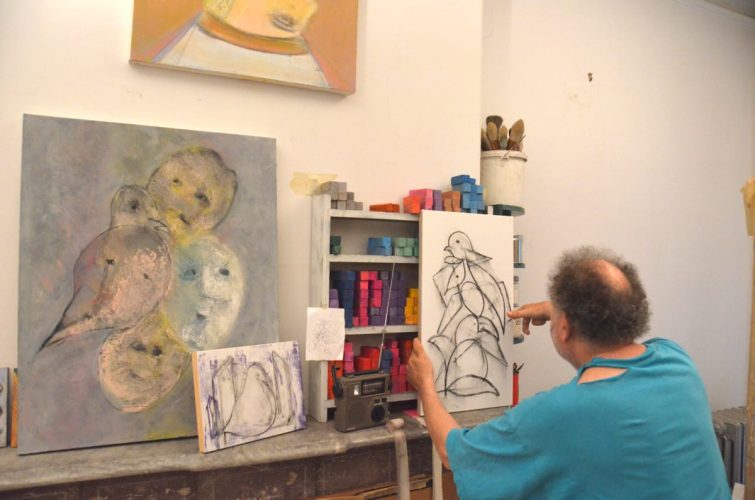
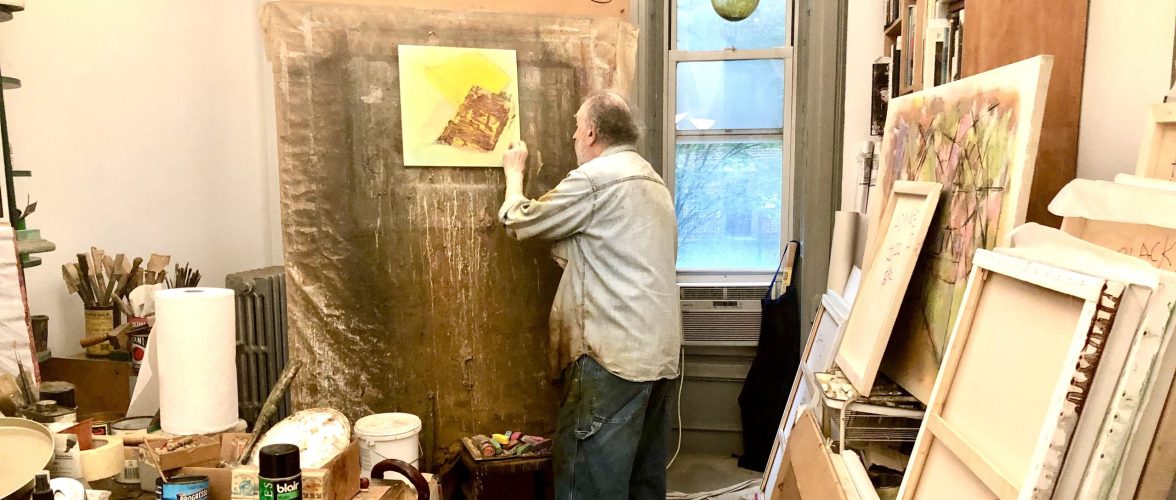
Basil’s diptych “A Predella for the Green Man”  (mixed media on two canvas panels, together measuring 42 inches high by 12 feet long) is complete. Process and progress from July 2012 to January 2013 was documented in photos by Sanjay Agnihotri and Martha King (with the more amateur shots by MK). See the slide show here. See also the blog page, above.

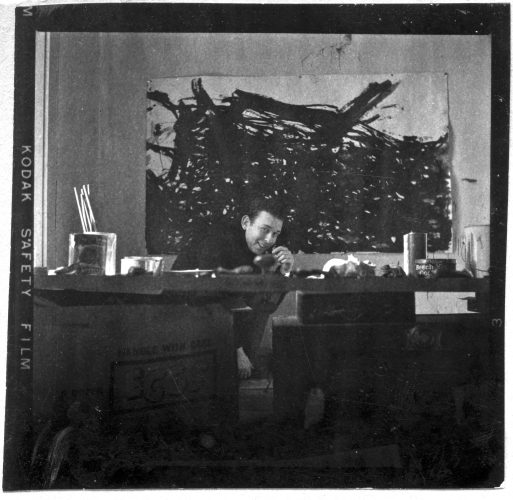
“Looking for the Green Man”  (mixed media on four canvas panels, 8 feet wide together with the two tallest panels each 74” high) was started in 2009.  We distributed a photo of this work as our holiday greeting in December 2009 (see thumbnail) but early in 2010 Baz hid the painting behind black cloth.

Back in 2009...

Back in 2009…


It was off. It was not done. He waited.  In January 2013 when “A Predella” was complete, he was ready to begin again.

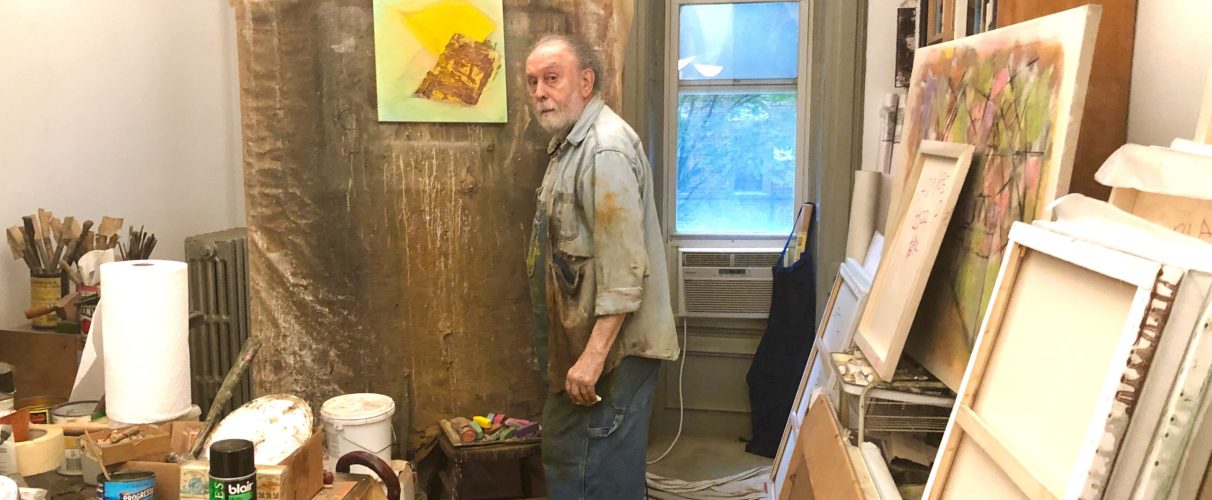
The two paintings are now on view in his studio.

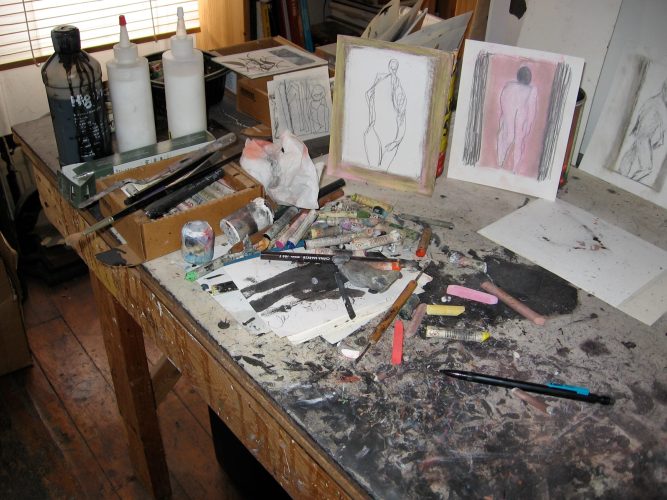
Studio table...sometimes waiting is working

Studio table…sometimes waiting is working


Martha King Memoir (Outside Inside) Poetry Writing

Martha King died – Martha J. King, 1928-2011

The other Martha King died more than a year ago. But because she was a skilled and frequently published translator and editor of writings by Italian women, she will continue to be the “other Martha King.”

Martha J. King, editor and translator

Martha J. King, editor and translator

Information about her books and editorial work can be found  here.

A very touching tribute to her by her son Jim is on YouTube here:

She lived in Tuscany for almost three decades and is probably best known for her translations of Grazia Deledda, winner of the Nobel Prize for Literature in 1928. This translator’s note gives a hint of her personality.

It seems paradoxical that Grazia Deledda could write such sexy novels, with characters driven by desire. She was born and raised in retro Sardinia, to become a faithful and devoted wife and mother. Short, plump, the antithesis of sexy, she wrote many volumes of short stories and novels with full-blooded themes, not to mention full-bodied. But subtly so. Her characters are very Sardinian-reticent in the expression of their desires that burn under the surface of the dialogue and action.

The Italians issued a postage stamp for Deledda.Grazia Deledda

My connection with Martha King began in 1978. New Rivers Press was bringing out my first real book, a collection of poetry, Weather. I wrote her about our shared name and suggested she alter hers to distinguish us. Could she use an initial?  She wrote back declining. I wrote back claiming seniority: I’d noticed that she earned a PhD in the early 1960s and assumed she was younger than me. I had had the King name first, I said, giving my age and the date of my marriage. (I have the King name from Basil.) I didn’t have any such claim. She was nine years older than me and had acquired her name though marriage in 1947.  Moreover, her mate had died just a few years before and she’d keep her name, thank you very much. Well, I did the same.

But I sent her a copy of Weather when the book was in hand and she wrote me back one more time.  She liked the poems very much and since she had not written them she promised to use her initial J. in the future.  Which she did and she didn’t but we didn’t write each other again.  Today we’re frequently mixed together on the web and on sites like Goodreads. I don’t care a bit.  We aren’t and weren’t the least bit alike but I’ve come to appreciate her integrity and valor.  RIP Martha J. King.


This is me.

This is me.


Martha King Memoir (Outside Inside) Prose

Fifty years

A daughter turns 50 this Groundhog Day

I have no concept to fit this.  50?  The other daughter is very soon 49.

I have an overstuffed memory.  Shrink.  But I forget too much.  Stretch.  Personally I’m sure I’m not older than 35. Maybe not even that.  In every fat man there’s a thin man, dancing.  In every grown-up, a child, who wants to play.  In every blended woman/man, some who chase and some who chase after. And some giggle and others sob. That’s normal. But a 50-year-old daughter?

Not a Canadian clergyman!  This was taken in our loft on Whitehall Street by Lynn St. John.

Basil drawing  on Whitehall Street in 1959. Photo by Lynn St. John.

Martha smokes a cigarette in North Carolina

Martha smokes a cigarette in North Carolina, 1961


I do remember a despicable doctor in Grand Haven, Michigan chastising me for using a toboggan “at your age.” (I was 35.) I do remember a nice neighborhood yoga teacher telling her class that people can do yoga in their fifties! (I was 61.)

Yesterday is tomorrow’s face. Shrink.

I’m only 28 years younger than my mother, who died in 2000 at 92. Stretch.

Accordians wheeze and are music simultaneously.

Our two children have children – the most normal thing in the world. But their dad and I are now their last bulwark. Everyone in the generation before ours has passed into the dark. Too many in the generation almost ours have done the same. I have no concept to fit this.

Except for an upwelling of gratitude, so acute as to be almost absurd. Stretch.

Except for a deep pinch of fear, so sharp as to need immediate denial. Shrink.

Withall, here is a section from my (unpublished) memoir about birth adventures fifty years ago…:

Births

1963-1964

Mallory was a tiny, skinny 17-month-old with a firm sense of herself the summer Hetty was born. Mallory is from the smaller order. She had weighed in at just two ounces over five pounds. The young nurses at New York Hospital solemnly and wrongly assured me she’d catch up. She was physically mature. She had exquisite blonde eyelashes and binocular coordination.

“Probably over-carried,” a young resident said, wowed by her ability to follow his finger with both eyes. He also assured me her small size hadn’t anything to do with the tumor she was born with, that walnut-like aberration, poking out of her mouth. It was attached by a thick stem coming out of the ridge in her jaw where her bottom teeth would be.

read more »

Martha King

Beans that are called peas

Collards and black-eyed peas, courtesy of Amy Ormand blog:

Collards and black-eyed peas, courtesy of Amy Ormand blog:

Amy Ormond, New Year’s Day Traditions:   http://amyormond.com/?p=284


Truthfully black-eyed peas are already made.  Open the bag, rinse and pick over (because sometimes there’s a stone or a lump of dried dirt)….and go.  Put in large pot and cover with cold water and salt (I never measure, use somewhere between a tea and a tablespoon.) Leave overnight.

To cook, I strain the soaking water and start over.  Baz never does.

In a large pot, saute chopped yellow onion – two small ones or one large – in a bland cooking oil, add one or two finely chopped garlics, and if you have it, julienne a thumb of fresh tumeric. Adds a mustardly flavor.  Throw in the soaked beans, add ample black pepper, salt, and water to cover. Or a little veggie or chicken stock optional. Or a bit of smoked hamhock. Or an old bare hambone unless vegans are coming to dinner. Bring to a boil. Skim the foam & lower heat to a simmer.  Or use a crockpot for 5 – 6 hours.  These peas take a good long time to become soft, but that’s it.  They have a unique taste and don’t need anything much. Check and add liquid as needed.

Black eyes can be the main dish or a vegetable, can be vegetarian (hold the hamhock), or carnivorous, do nicely with a side of brown rice or cornmeal mush (aka polenta) or any of the strong Southern greens like steamed kale, mustard, or collards, are very happy with little sausage meat balls, enjoy a shake of Tabasco or Red Rooster, go in soups, and sing like angels.  (I’m making that up – but I do like Will I Am.)

Black eyed peas are totally wonderful with crisp fried bacon and that’s what we eat New Year’s morning. We gorge on bacon that one day and otherwise abstain. North Carolinians know black-eyed peas are required for a year of good luck the day the year turns.


Martha King

SICK

Too damn many mischievous metaphors about being ill. The FLOOO blows through and that silly tongue twister keeps repeating in my head:   as a flea and a fly in a flue… imprisoned so what could they do?

Said the flea “let us fly”

Said the fly “let us flee”

They floo through a flaw in the flew

Well, there must be one.  Been sick since December 31 I think.   What time is it now?  Got better, got worse again.  My cheerleader Baz keeps insisting:  We Are Better.  Better than?   Bitter batter.  Betty bought a brick of better butter…

See what I mean?  Surely there has to be a way to stop this thing!

Where are my Neanderthal genes when I need ‘em most?  Just thickening my bone structure, already a tell-tale indication that I may have more than the normal 2-3% Neanderthal hold-overs sequesting in my de-oxy-ribo-nu-cle-ic molecules…. Thick bones never did anything for me personally but what about those 200,000 year old adaptations, saved through the generations because they confer immunity to Northern European VIRUS ??   Eh?   Now that you’ve been rehabilitated,  bleached, and relieved.

©2008 National Geographic Society

Martha King Prose Prose Pros series Readings Writing

The Prose Pros Reading on December 6

Andrew Levy and Andrej Blatnik were presented by Prose Pros at the Side Walk Café, December 6, 2012.

You can put Everything in –

Less is more  –

Charles Olson said something about space as the essential American condition…am I misquoting?  misremembering?  Certainly space is a foundational premise in Andrew Levy’s prose work.  It is not collage! It is his essential understanding of and belief in S P A C E that allows him to range through satire, horror, tenderness, nostalgia, massive political anger, joy in small day events, the beautifully captured voices of those routinely unheard, the voices that din our ears relentlessly.  Put it all in. And do it seamlessly.   All, everything, goes into his work, carried together by nearly invisible changes, the changes of jazz, the shifts we accept unquestioningly when they are NOT language (or not language because the language is so abstract as to snap the links of meaning) – but rarely encountered when words retain meanings as Levy’s do.

Listening at the Side Walk Cafe

Space –  as a means to incorporate, to take account of, to manage and make of  the barrage we’re living in and under…  No surprise at all that Andrew lost track of time as he read – and we did too, although time is a condition for the monthly readings Elinor Nauen and I host at Side Walk Cafe.  We are given an early slot, exactly 6:30 to 7:45 before the live bands, always on offer, start up.

The new novel (so he called it), that Andrew read from last Thursday  (I’d prefer to call it “prose work” as transcends the rote definition we all have of NOVEL) is still in progress and thus not yet available.  His recent Nothing is in Here from EOAGH is available for $17 from SPD.  Be rewarded. And expect to have your person personally engaged.   www.spdbooks.org

Andrew Levy reading

Andrej Blatnik reading


The second reader was our guest from Slovenia, Andrew Blatnik, master minimalist.  I don’t say that lightly.  His fictions aren’t short as a “demonstration” of just how short a word-thing can be. Kostelanetz has a series of one- and two-word novels as have several others: they are plays on a possibility. They can set off a chain of music but they are not actual stories.  Blatnik’s are.  Stories. Huge stories with layered complications – about people and relationships we all too easily recognize. They are presented in brief straight-forward sentences, often simple no-frills declarations, and not too many of them. But selected and attached with precision. Not to give us his audience distance but straight and simple to go for the throat. They are devastating and hilarious. They are cruel and heart-breaking. They are clearly true and just as clearly tales from the interior.

Happily Dalkey Archive is aware of Slovenia and much more and Andrej’s book can be ordered from  www.dalkeyarchive.com/  for $11.  (BTW,  poke around the Dalkey site if you are not aware of their Global Translation Initiative. )


Martha King

Week of the election – Tempests

Was the dawning week just after Sandy warped time. Just after standard time returned. Just after, just after. Was the week we saw, on Tuesday evening, The Tempest as opera, music by Thomas Ades, script by Meredith Oakes. We were gifted wonderful seats.

It was Election Day—an evening when I will do anything to avoid breathless TV pundits, explaining it all to me.

Tempest upends everything. Tempest upended the expected ending—and the change of script is brilliant!  The more time passing since Sandy passed the more upended we know we have been and will be.

At Rockaway… (Getty Images)

What kind of vengeance can there be?  Will summer cottages be rebuilt on these skimpy barrier islands, effectively strips of offshore sand bar?  We can’t think NOT. We can’t think YES either.  The Jersey Shore has long since disappeared behind hefty cement banks lining shore roads from Sandy Hook to Cape May.  Each year, more groins, more imported sand, more reinforcement for the beach walls.  Routine surges of two or three, of ominous four feet have flattened dunes and lapped up beach space almost every winter. Many homes along on the Jersey oceanfront have sprouted second-story balconies—to have an ocean view over the wall.

Tempest upended the expected ending—and the change of script is brilliant!  The humans all return to ordinary life in Naples. To promises of political reform, to young love consummated, to Stafano and Trinculo unchanged as they are ever. (Trinculo sung by an hilarious counter-tenor Iestyn Davies.) Home all, to reconciliation, the seductive rival of justice.  It is not a magisterial Prospero who reinstates order on the island before breaking his staff, drowning his book.  This Prospero is solid sexy in multicolored tats; biker beaux art, mercurial and irritable, not composed in his power.

Simon Keenlyside as Prospero. Photo: Ken Howard/Met Opera, www.metoperafamily.org

When staff and book are gone, something alien remains.  Prospero robes up in clothing normal for a duke and leaves.  It’s Caliban and Ariel (after a torrent of Meredith Monk-like riffs) who together–on tiptoe– recast the island into something else. Magics for good and ill are bound there, and the new script allows that they, they alone, claim it.

Audrey Luna as Ariel. Photo: Ken Howard/Met Opera, www.metoperafamily.org

Tides and grasses, oysters, slime, horseshoe crabs.  Many strange shapes.  Odd music all the humans comment on.

About 400 homes on the city’s barrier-island neighborhoods are being bulldozed today. Another 500 are still to be inspected to see if they too are so damaged they go on the list. This total is in addition to almost 200 others burned down or completely washed away.  Almost all are one- or two-family houses. Bits of cherished blue-collar heaven. Staten Island, Queens, Brooklyn. The sites will be sand.

Who sings of father’s eyes?

Afterwards we came home up our leaf-littered but otherwise normal Park Slope street to hear the jubilant voices of our black neighbors, many of whom had shared with us the three-hour wait to vote that morning.  “He’s really in?  Romney has conceded?” “Don’t worry. He’s got it.” As if Joe Louis had just finished off Max Schmelling. Upended.

Calm summer morning, East Hampton


ART Basil King Martha King Movies Poetry

Students at UNNCArts comment on “Basil King: MIRAGE”


Julian Semilian


Filmmaker and poet Julian Semilian screened the film for his students in experimental film at the University of North Carolina School of the Arts (Winston-Salem). (The school’s ‘movie street’ is seen above.) He sent these comments:

I can see why Nicole insisted on blu ray. It looked spectacular. It also made a huge difference seeing it on a large screen.

This is the first time that my students were THAT talkative after a movie. One of the comments was that this was a film made by an artist about an artist. They emphasized this more than once.

We had looked at films about other artists (Motherwell, Rothko, Bourgeois, Eggleson, Robert Frank) but never before did they feel that involved. The main thing…they liked was that the filmmaker stayed out of the way of the subject….They loved the construction, blending the art with Baz’s reading of his auto-biographical poem, so that we get to know the fusion and mirroring of Baz and art. And they really appreciated seeing the art so large. At the end…I spoke to them about Black Mountain (only one student knew a little about it), some of the other principal characters, and about Frank O’Hara. Next week I am going to read them some O’Hara poems. All in all, a splendid evening. I felt happy and proud to make a connection between the generations.